Bridging Research, Innovation and Digital Transformation: A Comprehensive Review of the 10th National Conference on Communications — NCC 2026
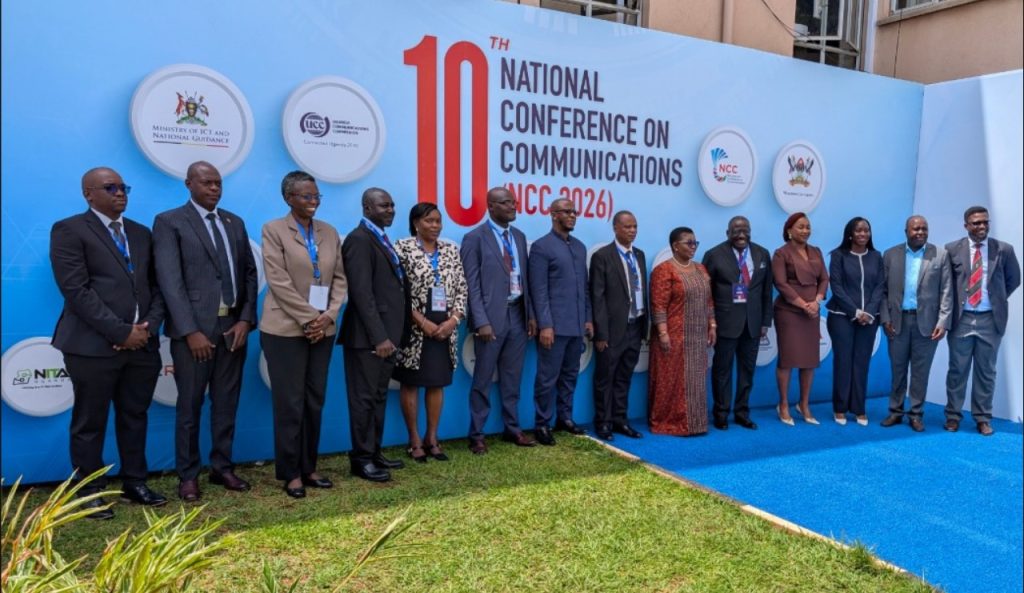
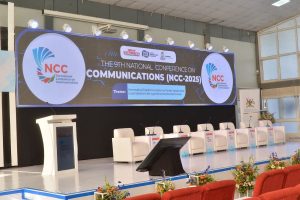
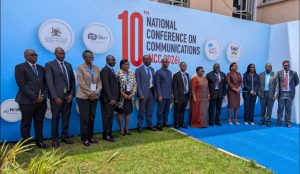
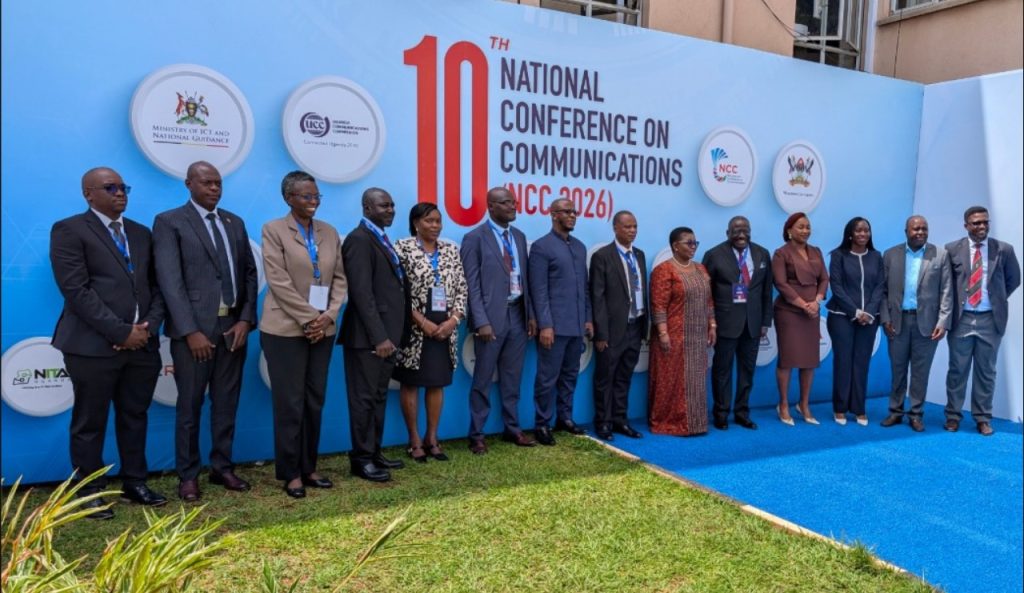
Uganda’s 10th National Conference on Communications closed at Makerere University on September 25, 2026 after two days of research presentations, policy dialogue, industry engagement and student innovation. Held at the Yusuf Lule Central Teaching Facility on September 24–25, the conference was organised by the Uganda Communications Commission (UCC) and hosted in collaboration with Makerere University’s College of Engineering, Design, Art and Technology (CEDAT). Its official theme was “Accelerating Market-Driven Research and Innovation for Uganda’s Development.”
For KAWA, the conference was particularly significant because it demonstrated the full innovation pipeline Uganda is trying to build: from secondary-school ICT Clubs identifying local problems, through university research and engineering, to regulators, government agencies and companies considering how ideas can become market-ready solutions.
NCC 2026 was therefore more than a conference marking a tenth edition. It became a meeting point between research and application, classrooms and industry, young innovators and experienced professionals, regulation and entrepreneurship.
A milestone edition focused on research that reaches the market
The National Conference on Communications was established as a platform for bringing together researchers, students, government, regulators and industry actors around communications research and technological innovation. The NCC has developed across nine previous editions hosted by institutions including Makerere University, Mbarara University of Science and Technology, Ndejje University, Kyambogo University, ISBAT University and Gulu University. NCC 2026 was presented as the tenth milestone edition, with a national footprint spanning five regions and four core constituencies: academia, industry, government and youth.
That structure was strongly reflected in the 2026 programme. Rather than treating research as something that should end with a university paper, this year’s programme continually returned to one question:
How can research become a usable solution, product, service, enterprise or public policy intervention?
UCC Executive Director Hon. George William Nyombi Thembo had already framed the conference in this direction at its April launch, describing NCC as a platform for presenting peer-reviewed research, discussing emerging technological issues and connecting young professionals with experienced practitioners. At the main conference, he again called for research to move beyond knowledge generation towards practical, market-ready solutions to local problems.
That emphasis gives NCC 2026 particular relevance to Uganda’s young researchers and innovators. A technically impressive prototype is valuable, but its potential becomes greater when its developers also ask whether it is affordable, scalable, secure, maintainable and useful to actual communities.
National leadership, academia and industry meet at Makerere
The opening programme reflected the multi-sector nature of the conference.
CEDAT Principal Prof. Moses Musinguzi and UCC Director of ICT and Research Eng. Christine Mugimba gave the opening welcome remarks. The programme then featured Paul Isaac Musasizi, Chief Executive Officer of Kiira Motors Corporation, on building Uganda’s innovation ecosystem; Dr. James Kisaale, Executive Secretary of the Uganda National Council for Science and Technology, on research commercialisation and closing the innovation value chain; and Eng. Dr. Julius Butime, Dean of the School of Computing and Engineering at Strathmore University, on shared infrastructure and innovation markets.
The formal opening programme included Makerere University Vice Chancellor Prof. Barnabas Nawangwe who was represented by Prof. Moses Musinguzi, UCC Executive Director Hon. Nyombi Thembo, and Uganda’s Minister of ICT and National Guidance, Rt. Hon. Justine Kasule Lumumba.
The Official Master of Ceremonies was Mr. Michael Niyitegeka, a renowned tech enthusiast and leadership development practitioner. He is the Executive Director of Refactory Academy and Program Director at Clarke International University, and formerly served as the ICDL Africa Country Manager for Uganda. Passionate about Business Technology Strategy, Business Advisory, and Youth Empowerment, he is widely respected for his eloquence, professionalism, and ability to engage audiences.
From connectivity to commerce
One of the strongest messages running through the programme was that Uganda’s digital transformation cannot be measured only by internet connections or the number of applications developed. The next question is what those connections make possible.
A major industry panel was therefore organised around “From Connectivity to Commerce: Turning Uganda’s Digital Development Vision into Market Reality.” Its scheduled participants included executives from ATC Uganda, MTN Uganda, Airtel Uganda, the Internet Service Providers Association of Uganda and Kilimanjaro Telecom.
This was complemented by broader discussions around enabling regulation, digital infrastructure and innovation markets.
The conference’s formal research tracks similarly ranged across digital infrastructure and future networks, digital financial services, media and broadcasting, smart societies, artificial intelligence, agriculture, cybersecurity, public policy and innovation ecosystems. The conference also explicitly included issues such as 5G and future networks, rural and last-mile connectivity, mobile money, digital lending, cybersecurity, privacy, universal access, digital agriculture and research commercialisation.
For Uganda, these are not abstract technological discussions. They directly affect whether a farmer can obtain market information, whether a learner can access a digital resource, whether a small enterprise can receive electronic payments, whether public data is protected, and whether a rural school can participate meaningfully in the digital economy.
Commercialisation remained the missing bridge
An important strength of NCC 2026 was its willingness to address a familiar problem in African research systems: good research does not automatically become a usable product. A technically excellent university project may remain on a shelf. A promising student prototype may stop after a competition. A paper may be published but never reach the community whose problem inspired it.
NCC 2026 deliberately placed commercialisation and industry engagement at the centre of the conversation. The official industry programme described the objective as bridging academic theory and real-world impact through industry talks, exhibitions, partnerships, research collaboration, technology transfer and opportunities for companies to engage directly with researchers and students.
This is where Uganda’s innovation ecosystem will increasingly need to concentrate. Researchers need access to markets and investment. Industry needs access to new ideas and skilled talent. Government needs evidence for effective policy. Schools need pathways through which a promising learner can progress from experimentation to deeper engineering and entrepreneurship. NCC can help connect these stages.
The KAWA highlight: School ICT Clubs take the national stage
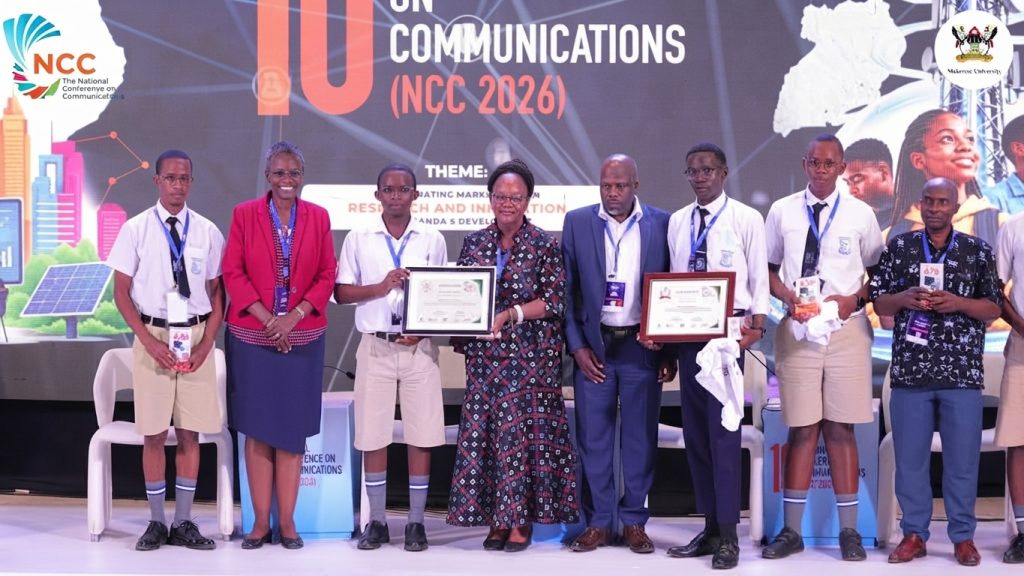
For KAWA, one of the most important parts of NCC 2026 came on the second day when Uganda’s secondary-school ICT Clubs took to the national stage. The journey to that stage had begun much earlier. 228 schools expressed interest, 108 qualified, 72 reached the regional competition stage, and 129 innovation projects were entered. From this large field, only eight schools reached the national finals, six regional winners and two special-inclusion teams from Karamoja advanced to the national showcase.
The eight finalists were:
| School | Region / Qualification | Innovation |
| Trinity College Nabbingo | Central A regional winner | Cultiva, a data-driven agricultural/soil intelligence platform |
| St. Maria Goretti SS, Katende | Central B regional winner | Smart Wireless Hand-Gesture Controlled Wheelchair |
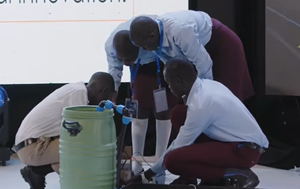
| Mbale Secondary School | Eastern regional winner | SMARTBIN, a touch-free smart trash bin |
| Mbarara High School | South-Western regional winner | Rent Ease, a digital rental-property management platform |
| St. Leo’s College Kyegobe | Mid-Western regional winner | Soma Analytics, a smart classroom/learning analytics solution |
| Maruzi Seed Secondary School | Northern regional winner | Smart Plant Irrigation System |
| Kangole Girls’ Secondary School | Karamoja special inclusion | Smart Lighting Control System |
| St. Andrews SS, Lotome | Karamoja special inclusion | Secure Karamoja |
Maruzi Seed Secondary School takes the national title
At the national finals, Maruzi Seed Secondary School emerged as the overall national winner with its Smart Plant Irrigation System.
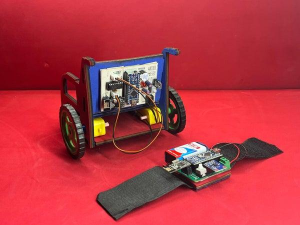
The system had been developed in response to a very practical agricultural problem: irregular rainfall and dry periods affecting crop production. The project’s regional profile described an Arduino-based system using soil-moisture sensors, relay modules and water pumps to monitor soil conditions and trigger irrigation when necessary.
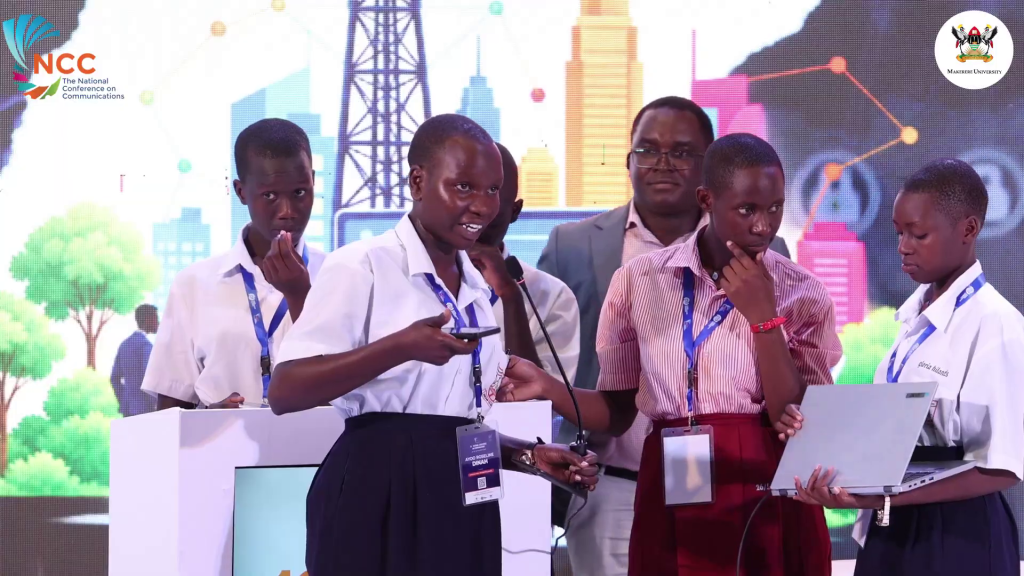
That is exactly the kind of innovation NCC seeks to encourage. It starts with a real problem. It uses available technology. It creates a working prototype. And it has potential application beyond the competition itself.
A smart-irrigation project developed by secondary-school learners can lead into wider discussions about climate resilience, precision agriculture, food security, water conservation and affordable farm automation.
Trinity College Nabbingo takes second place
Trinity College Nabbingo finished in second position nationally with Cultiva. This is a data-driven soil-intelligence platform designed to connect idle agricultural land with prospective cultivators using soil information, while also incorporating an offline AI-assisted crop-disease feature.
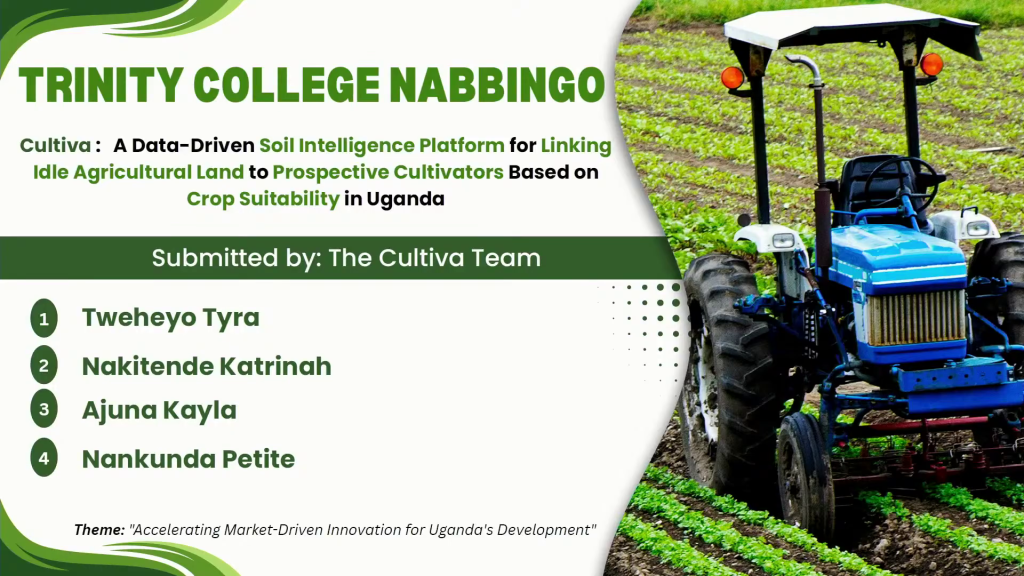
The project demonstrates that school innovation is moving beyond basic computer applications. Learners are beginning to think about: data, artificial intelligence, agriculture, local language accessibility, and national production challenges within the same solution.
St. Andrews SS Lotome takes third — a major moment for Karamoja
One of the most significant outcomes of the entire schools competition came from St. Andrews Secondary School, Lotome, which finished in third position nationally with its
Secure Karamoja: Bridging Educational Gaps and Livestock Security via Offline Mobile Learning Kit.
Its national podium finish therefore carried a wider message. A school does not need to be located in Kampala or another major urban technology centre to produce competitive ideas. With access, mentorship, opportunity and determined learners, innovation can emerge from every region of Uganda. That is especially important for Karamoja, a region too often discussed mainly through the language of disadvantage rather than potential. At NCC 2026, learners from Karamoja were not spectators. They were: designers, programmers, presenters and national finalists. And one Karamoja team reached the national top three

Kangole Girls: a special milestone for the UCC–KAWA ICT Clubs programme
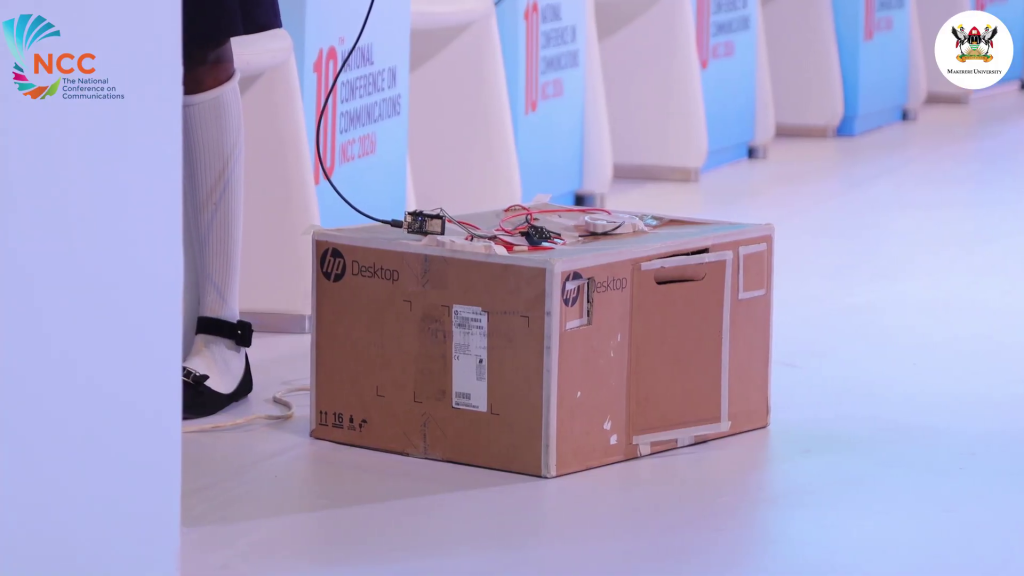
For KAWA, Kangole Girls’ Secondary School in Napak District carried special significance. KAWA had worked with the school under the national ICT Clubs programme supported by UCC/UCUSAF, launching and training its ICT Club in 2026. Months later, Kangole Girls progressed all the way to the eight-school national final with its Smart Lighting Control System, an ESP32-based mobile-controlled solution aimed at improving energy efficiency and reducing unnecessary electricity consumption in schools.
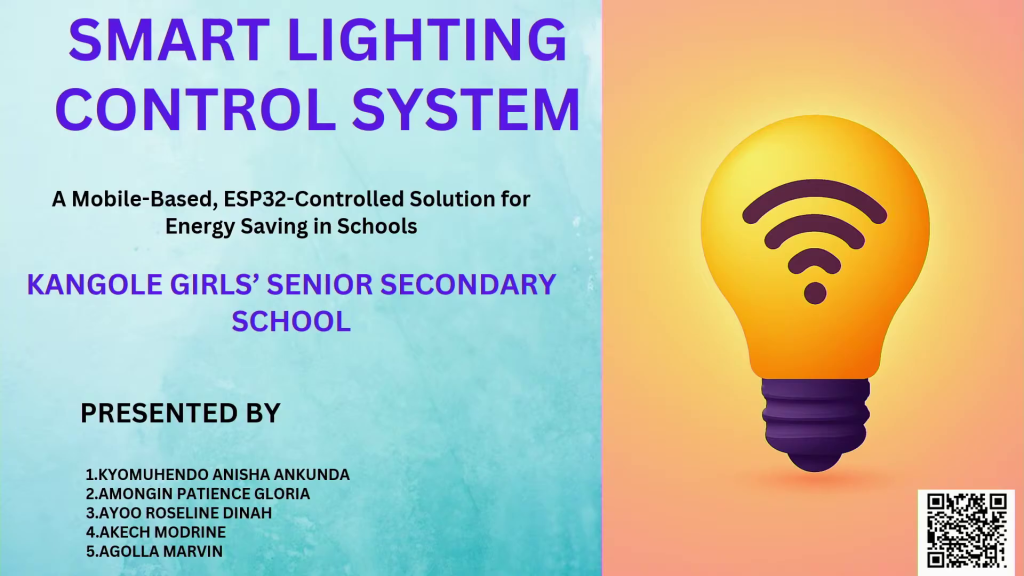
Among the eight national finalists, Kangole Girls was the school directly highlighted from the current UCC–KAWA-supported cohort. For KAWA, that journey matters as much as a trophy.
It shows what can happen when a school receives: consistent mentorship, an active ICT Club, supportive leadership, access to learning opportunities, and a national platform on which learners can demonstrate what they have built.
Beyond the winners: innovation is becoming geographically wider
KAWA’s experience in the ICT Clubs programme has increasingly shown that technology talent is not limited to the schools traditionally associated with national competitions. The NCC 2026 finalist group came from Central Uganda, Eastern Uganda, Western Uganda, Northern Uganda and Karamoja.
Two Karamoja schools were included at national level. A northern school became national champion. A Karamoja school finished third. These outcomes are important signals for Uganda’s digital-development strategy. If innovation programmes reach only already well-resourced urban institutions, the country will miss enormous talent.
The future of Uganda’s technology sector may include a programmer from Napak, an engineer from Apac, an AI researcher from Fort Portal or an agricultural technologist from Mbale. National programmes should be designed to discover that talent early.
The role of teachers and ICT Club patrons
Student innovators rarely arrive at national competitions alone. Behind each project are teachers and ICT Club patrons who: create time for meetings, open computer laboratories, help learners organise teams, connect them to mentors, encourage them after failure, and often continue supporting projects outside normal lesson hours.
KAWA therefore recognises the contribution of the patrons, headteachers, school administrators, parents and mentors who supported the NCC teams. The ICT Club model works best when innovation becomes part of the school culture rather than a once-a-year competition activity. The objective is not simply to prepare students to win NCC. It is to create schools where learners routinely ask: What problem can technology help us solve?
Building the pipeline from school ICT Clubs to university research
One of NCC 2026’s most encouraging features was seeing secondary-school innovation beside advanced academic research. A learner presenting an Arduino irrigation system could walk into another session and encounter research on: machine learning, electric vehicles, battery systems, artificial intelligence, language technologies, or high-voltage infrastructure. That exposure matters.
It allows a Senior Three, Senior Four or Senior Five learner to imagine a pathway:
ICT Club → school project → university study → research → prototype → enterprise → industry.
Uganda needs more of these pathways. Too many young people learn technology only as examinable theory. The ICT Clubs programme demonstrates another possibility: learners can use computers as tools for invention, design and investigation.
Academia, government, industry and youth — the four groups must remain connected
The NCC 2026 runs according to four central pillars. These are academia, industry, government and youth. Each has a distinct role. Universities can provide research expertise and laboratories. Government can build infrastructure, develop policy and support inclusion. Regulators such as UCC can create enabling frameworks and invest in programmes that expand access and experimentation. Industry can provide market knowledge, technical mentorship, investment and routes to scale. Schools can build the next generation of innovators.
But the greatest value comes when these groups are connected. A learner should be able to meet a university researcher. A researcher should be able to speak to an industry engineer. An industry leader should be able to communicate real technical problems to universities. A regulator should be able to identify where policy is blocking innovation. And a promising prototype should have somewhere to go after the conference closes.
Twenty-six peer-reviewed papers: research directed at Ugandan problems
Another central feature of NCC 2026 was its academic research programme. The conference accepted 26 camera-ready papers for presentation. What stood out was the involvement of the ICT club member and student of Lira Town college whose paper came out among the top best.
Andrew Ocepa of Lira Town College presented Fine-Tuning Neural Machine Translation for Leb Lango: A Low-Resource Approach Using MarianMT. The inclusion of a secondary-school-affiliated researcher among accepted NCC papers was itself notable. The research highlights a larger challenge in artificial intelligence: many African languages have significantly fewer digital resources than globally dominant languages. Building language technologies around Leb Lango therefore connects digital innovation with preservation, access and inclusion.
Akandwanaho Jonan of Makerere University presented work on an AI-Powered Multilingual Civic Information Platform for Uganda, illustrating how artificial intelligence and natural-language technologies could potentially make information more accessible across linguistically diverse communities.
Derrick Ankwasa of Makerere University presented the Design and Development of a Redundant Steer-by-Wire System for a Driverless E-Shuttle, linking computing, control systems and engineering to the emerging local electric-mobility ecosystem.
Walter Anyeki of Makerere University examined machine-learning methods for estimating the state of health and remaining useful life of repurposed electric and hybrid vehicle batteries for microgrid energy storage. This is especially relevant as countries consider how batteries can continue serving useful purposes after their first automotive life.
Bruce Baguma of Makerere University presented research on machine-learning-based monitoring of high-voltage transmission corridors. This showed another important dimension of artificial intelligence: it is not only for chatbots or consumer applications; it can also support monitoring of critical physical infrastructure.
Together, these papers illustrated the breadth of modern communications research. The field now intersects with agriculture, transport, language, energy, education, public administration, cybersecurity and infrastructure.
Strong institutional collaboration behind NCC 2026
NCC 2026 was principally organised through the partnership between UCC and Makerere University CEDAT, with the official conference site also identifying RENU among its strategic partners.
The wider conference programme drew participation from institutions across Uganda’s public and private technology ecosystem. Panel and invited-speaker programmes included organisations such as ATC Uganda, MTN Uganda, Airtel Uganda, the Internet Service Providers Association of Uganda, Kilimanjaro Telecom and Roke Telkom, alongside regulators, public agencies, researchers and universities.
KAWA also recognises the wider institutional ecosystem that supports school and national digital transformation, including UCC/UCUSAF, the Ministry of ICT and National Guidance, Makerere University, RENU, NITA-U, UNBS, participating schools and the many organisations that provide infrastructure, mentorship, standards, research support and opportunities for young innovators.
From prototypes to sustainable solutions: what should happen next?
The end of NCC should not be the end of the projects. For the school teams, the next stage should involve further testing, documentation, user feedback and mentorship. Can Maruzi’s irrigation system be tested with farmers over an entire growing season? Can Cultiva validate its recommendations with agricultural experts and real land users? Can Edusecure Karamoja and the AI Smart School be tested in a functioning school environment? Can Kangole Girls quantify exactly how much electricity its smart-lighting system saves? Can SMARTBIN withstand daily school use? Can the smart wheelchair continue to be improved with users who have mobility challenges involved in its design? These are the questions that move innovation from prototype to product.
Uganda’s challenge is no longer a shortage of ideas alone. It is building stronger systems for taking good ideas through research, testing, intellectual-property support, product development, financing, certification, procurement, and eventually market adoption. That is why NCC 2026’s emphasis on market-driven innovation was timely.
KAWA’s commitment beyond NCC 2026
For KAWA, NCC 2026 confirms the importance of continuing to strengthen ICT Clubs as spaces where young people become creators rather than passive consumers of technology.
KAWA’s work with UCC and UCUSAF has focused on building sustainable school ICT Clubs, strengthening teacher mentorship, expanding practical digital skills and connecting learners to national opportunities. KAWA’s ICT Clubs platform records a network extending to hundreds of schools, with learners participating in activities ranging from web development and digital content creation to applications, innovation projects and community digital-skills initiatives.
The long-term objective is larger than competitions. Uganda needs learners who can: identify problems, conduct basic research, work collaboratively, build and test solutions, communicate ideas, use artificial intelligence responsibly, understand cybersecurity, and eventually create employment and enterprises from technology. NCC provides an important national destination for that journey, but the work begins inside the school.
Conclusion: NCC 2026 leaves Uganda with a challenge
The 10th National Conference on Communications successfully brought together the different parts of Uganda’s innovation ecosystem at Makerere University. Twenty-six accepted research papers showed the depth of technical inquiry taking place in universities and schools. Government and regulatory leaders discussed the conditions needed for digital transformation. Industry leaders pushed the conversation from connectivity towards commerce and scale. Researchers demonstrated how AI, communications systems, energy technologies and digital platforms can respond to local challenges.
And on the second day, secondary-school learners demonstrated something equally important:
Uganda’s innovation pipeline can begin in a school ICT Club.
Maruzi Seed Secondary School’s national victory with its Smart Plant Irrigation System showed the potential of technology designed around an immediate local need. Trinity College Nabbingo’s second-place Cultiva project showed how data and artificial intelligence can be brought into agricultural problem-solving. St. Andrews SS Lotome’s third-place finish showed that a Karamoja school can stand among Uganda’s strongest student innovators.
And Kangole Girls’ journey from a UCC–KAWA-supported ICT Club in Napak to the national NCC final demonstrated why investment in digital inclusion must continue reaching schools that have historically had fewer opportunities.
NCC 2026 is over. The more important work now begins. The research must move beyond papers. The prototypes must move beyond exhibitions. The students must continue learning. The universities must stay connected to industry. Industry must continue opening doors to young innovators. And national institutions must keep creating pathways through which a good Ugandan idea can become a solution that reaches Ugandans.
That is how research becomes innovation, innovation becomes impact, and digital transformation becomes meaningful development.
KAWA congratulates UCC, Makerere University CEDAT, the NCC 2026 organising team, all researchers and speakers, the ICT Club patrons, participating schools, mentors, judges, parents and, above all, Uganda’s young innovators who made the 10th National Conference on Communications a memorable national platform for learning and innovation.
The future is not simply something Uganda’s young people will inherit. Through programmes such as the School ICT Clubs, they are already helping to design it.